
The DeFi Execution Layer, Solved: Why Global Capital Aggregators Cannot Scale on Retail Rails
How AetherNet's Cryptographic Airgap and Canton Network privacy eliminate MEV, front-running, and execution latency for institutional-grade yield strategies
 Kronova Team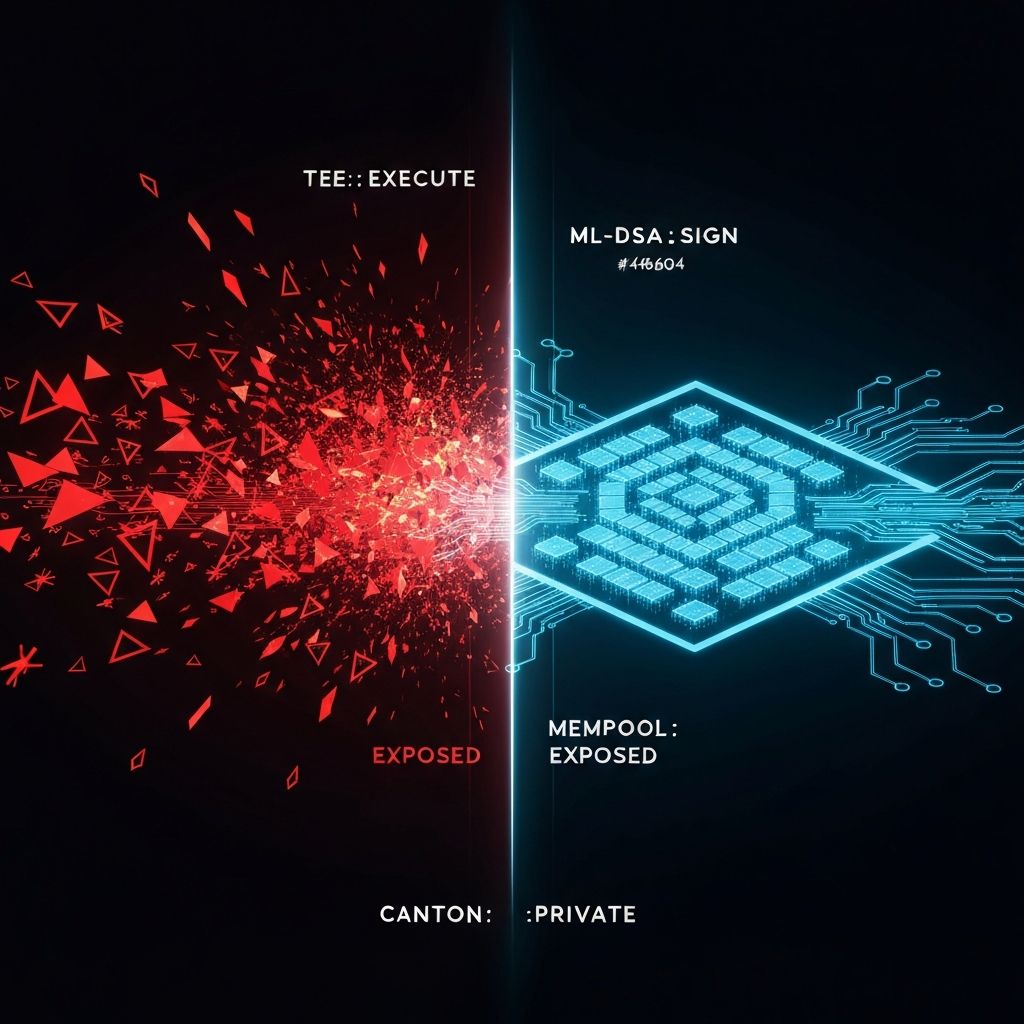
! Executive Summary
By early 2026, premier decentralized lending markets were managing over $46 Billion in institutional-grade deposits. The market has proven that traditional financial assets can be tokenized. The next frontier — institutional-grade performance and privacy for sophisticated yield strategies — remains unsolved.
The critical bottleneck is not block throughput. It is the Public Mempool Architecture: a structural design that exposes financial intent before execution, enabling MEV extraction, sandwich attacks, and balance sheet surveillance. AetherNet replaces the public mempool with a Cryptographic Airgap secured inside a hardware-isolated Trusted Execution Environment, delivering zero-slippage execution and mathematically provable fairness for the world's most sophisticated capital operators.
The Performance Trap: Retail Rails Cannot Scale Institutional Capital
In early 2025, Total Value Locked in tokenized U.S. Treasuries surpassed $10 Billion globally. By early 2026, the industry's most sophisticated DeFi protocols were managing tens of billions in institutional deposits. The tokenization thesis has been validated.
But validation of the asset class does not validate the execution infrastructure. While the industry's focus remains on scaling public blockchains to handle more transactions per second, a far more critical bottleneck continues to compound losses for high-fidelity capital managers: the architecture of the public mempool itself.
"You cannot build a billions-of-dollars institutional yield engine by writing better Solidity code. You must fundamentally rethink the execution layer."
Global capital aggregators and omnichain asset managers — currently managing over 25% of all DeFi TVL — are operating on infrastructure designed for retail consumers. The mismatch is not marginal. It is structural.
The Architecture of Value Leakage: The Dark Forest
Current DeFi protocols operate in what researchers have described as a "Dark Forest." When a cross-chain asset manager routes $50M from an institutional yield vault into a perpetual DEX or staking protocol, that transaction intention is broadcast publicly before execution. Three structural vulnerabilities compound the damage.
MEV and Sandwich Attacks
$24M extracted from Ethereum users in a single 30-day period, early 2026
Searchers and block builders can rearrange the order of pending transactions with mathematical precision. For high-volume yield routers, this produces persistent, compounding slippage that systematically erodes yield alpha on every execution cycle.
Worst-case exposure: In isolated mempool failures, single users have lost over $50 Million in a single swap due to routing vulnerabilities. For institutional operators, this risk profile is categorically unacceptable.
Trade and Balance Sheet Visibility
Public block explorers broadcast private treasury strategies to every competitor
Traditional institutions cannot tokenize their balance sheets or Treasuries if their competitors can track real-time capital movements. Every routing decision, every position size, and every counterparty relationship is indexed permanently on public block explorers. For regulated custodians and family offices, this is a structural disqualifier — not a trade-off.
Cross-Chain Execution Latency
Block-time latency on every leg destroys high-fidelity yield optimization
Capital managers coordinating assets across multiple chains face multi-second block-time latency on every transaction leg. High-fidelity yield optimization requires sub-millisecond routing decisions — a requirement that public block architectures cannot physically satisfy regardless of validator count or consensus mechanism improvements.
The solution is architectural, not incremental: To capture the next tranche of global capital, the industry must decouple execution from settlement — delivering the speed and fairness of a centralized matching engine, secured by the non-custodial finality of a decentralized ledger.
The Solution: The Privacy-Preserving Execution Layer
AetherNet was engineered to solve the institutional execution problem across two critical verticals. Each vertical addresses a distinct failure mode in the current infrastructure landscape.
Omnichain Capital Aggregators
AetherNet TEE Execution — The Cryptographic Airgap
Omnichain capital aggregators perform the heavy lifting of bridging dormant capital — tokenized Bitcoin reserves, dormant corporate Treasuries — into yield-bearing DeFi strategies. When these protocols route millions into lending pools, perpetual DEXs, or staking vaults, they cannot expose that transaction flow to public mempools.
AetherNet replaces the public mempool with a Cryptographic Airgap. Capital aggregators submit encrypted intents directly to AetherNet's hardware-secured Rust Trusted Execution Environment. The architecture delivers three properties simultaneously:
The TEE decrypts and routes yield strategies in sub-milliseconds inside isolated memory. No external observer — including Kronova's administrators — can see the order flow.
Users do not trust AetherNet. They trust the Remote Attestation. The TEE hardware generates a cryptographic hash of the Rust execution algorithm verified by the client wallet before any trade is submitted.
The TEE generates a post-quantum ML-DSA signature finalizing state and submits only the net result to the public blockchain for settlement. Searchers are blinded at the source.
The trust model: If one line of the Rust execution algorithm changes to front-run the user, the attestation hash breaks and the trade aborts automatically. The fairness guarantee is mathematical, not contractual.
Institutional Asset Managers and Treasuries
Canton Network Privacy — The Confidential Settlement Layer
Tokenization protocols targeting family offices and regulated custodians require infrastructure where they can manage tokenized reserves without exposing their alpha to public surveillance. AetherNet utilizes the decentralized Canton Network and Daml smart contracts to provide absolute sub-transaction privacy for underlying asset movement.
Regulated institutions deploy their own Canton nodes, ensuring capital remains entirely behind corporate firewalls — no third-party custodian, no shared infrastructure.
Using Daml's observer pattern, transaction details are sharded on a strict need-to-know basis. Nodes on the same Canton domain cannot read, index, or detect the metadata of a private settlement.
Institutions gain a compliant dark pool environment for managing billions in tokenized deposits or reserves — structurally identical to traditional institutional settlement venues.
The architecture enables seamless, compliant use of privacy-preserving stablecoins like USDCx for cross-institutional settlement without regulatory exposure.
Canton's privacy guarantee: Only parties explicitly named in a Daml contract can observe its state. This is not obfuscation or policy — it is enforced at the cryptographic protocol level, making confidential enterprise settlement structurally guaranteed.
Public Mempool vs. AetherNet Execution
| Dimension | Public Mempool | AetherNet TEE |
|---|---|---|
| Transaction Visibility | Broadcast-public before execution | Encrypted inside TEE — zero leakage |
| MEV Exposure | Structural — inherent to architecture | Eliminated — searchers see nothing |
| Execution Latency | Multi-second (block time) | Sub-millisecond inside isolated memory |
| Fairness Guarantee | Policy-based (operator promises) | Mathematical — Remote Attestation hash |
| Settlement Privacy | Permanently public on-chain | Canton sub-transaction private |
| Cryptographic Standard | ECDSA (quantum-vulnerable) | ML-DSA (NIST post-quantum standard) |
| Target Operator | Retail users, small protocols | Omnichain aggregators, institutions |
The Missing Architecture of DeFi
The tokenization of real-world assets is not a theoretical exercise. It is a multi-trillion dollar market migration underway right now. The financial infrastructure required to support it is not a faster public blockchain — it is a privacy-first, quantum-resistant, off-chain execution layer that can process institutional capital without exposing it to adversarial public infrastructure.
AetherNet is that layer. The Cryptographic Airgap closes the Dark Forest. Canton Network provides the compliant private settlement that regulated institutions require. The combination creates the only institutional DeFi execution stack that is simultaneously MEV-proof, quantum-resistant, and compliant by design.
"The industry built roads. AetherNet builds the armored vehicles that move real institutional value safely on those roads."
The future of institutional DeFi is not built on public mempools. It is built on cryptographic guarantees, hardware-isolated execution, and sub-transaction privacy. AetherNet delivers all three — in production, today.
Secure Your Enterprise Pilot Slot
AetherNet is accepting select partners for our Q2 2026 private alpha. If you manage institutional capital and require MEV-proof, privacy-preserving execution infrastructure, contact Kronova today.

